
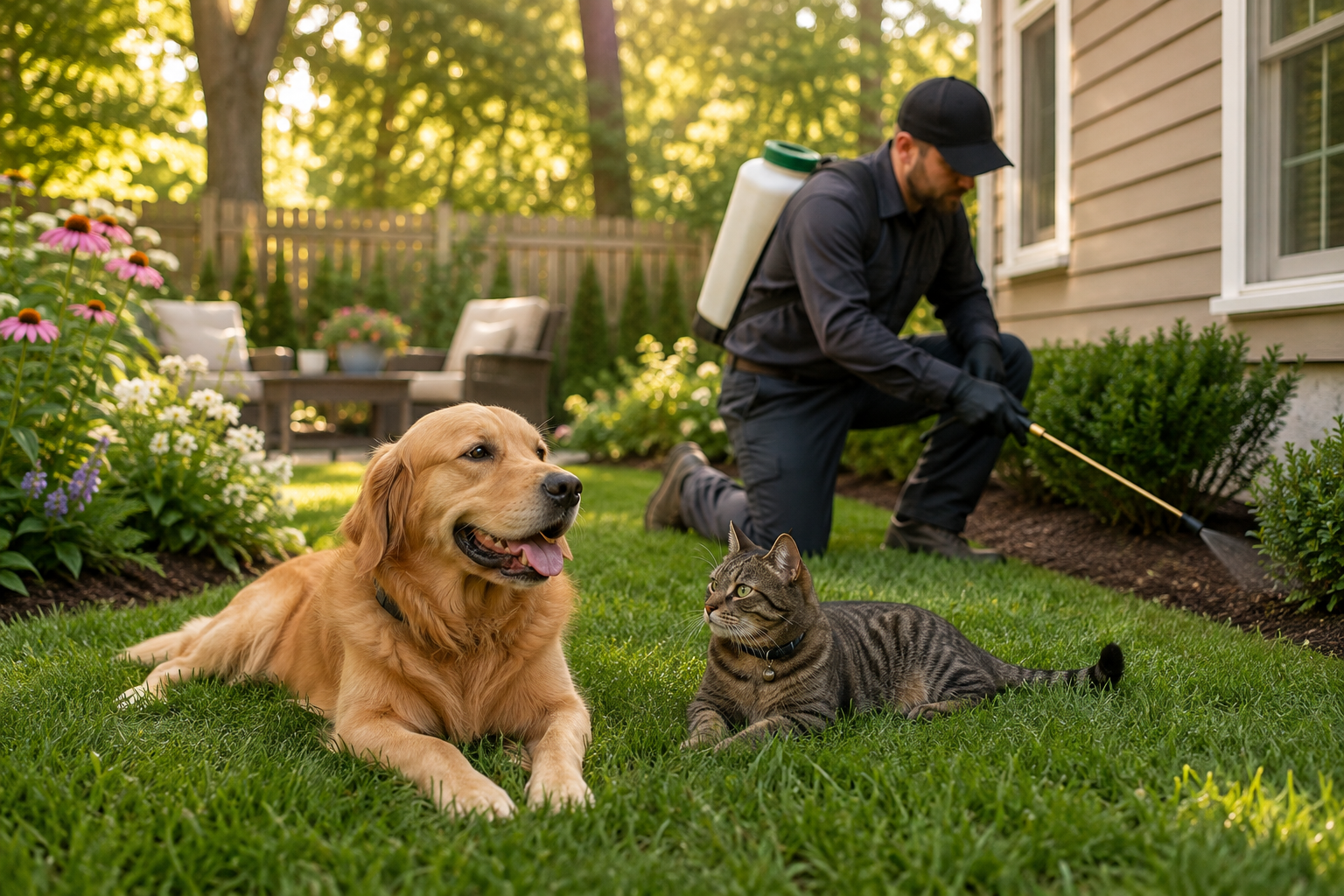
"Pet-safe" gets used loosely in pest control marketing, and it's not always clear what's actually behind the label. If you're a dog or cat owner trying to deal with an ant trail, a spider problem, or something worse, you should get a full picture of what exactly you are dealing with instead of a mere reassuring word on a website. Below, we'll walk through what pet-safe pest control actually involves, how it's different from a conventional approach, and what that means for your kids, pets, and the pollinators in your yard.
What Pet Owners Need to be Aware Of
Dogs and cats interact with a treated yard or home far more directly than we do. A dog rolls in the grass, sniffs along the fence line, and grooms itself with its tongue. A cat walks through a treated baseboard and then washes its paws. That closer contact is exactly why the products used and how they're applied matter more for pet owners than for the average homeowner.
Pest control and pet ownership can coexist just fine. Details like what's being used, how much, and when your pets can go back outside, are what make it work.
What "Pet-Safe" Actually Means
No pest control product is entirely risk-free, and any company that claims otherwise isn't being straight with you. What "pet-safe" really refers to is a combination of choices that add up to lower risk:
- Low-toxicity active ingredients. Some pest control materials are formulated to be effective against target insects while carrying a lower toxicity profile for mammals like dogs and cats. Backyard Care Company selects materials with this in mind and skips whatever is cheapest or fastest-acting instead. That's also why we don't use pyrethrins in our programs.
- Precise application. Broadcasting a product across an entire yard isn't usually necessary. Targeting cracks, entry points, and known activity areas gets the job done with less overall product in places pets actually spend time.
- Reentry timing. Kid-friendly and pet-friendly programs account for dry time. Most treatments need to set for a short period before pets or kids go back into the treated area, and a trustworthy provider will tell you exactly how long that is.
Put together, that's what separates a genuinely pet-safe approach from a label slapped on a bottle.
How our Approach Differs from Conventional Pest Control
Conventional household pest control often relies on broad-spectrum products applied at higher concentrations, sprayed liberally to cover as much ground as possible in a single visit. It's fast, and it can look thorough, but it isn't always the most thoughtful approach for a home with pets and kids in the yard.
A low-toxicity program looks a little different:
- Materials are chosen for their profile against a specific pest, not just general strength.
- Application focuses on where pests are actually active such as foundations, entry points, nesting areas, rather than blanket coverage.
- Indoor and outdoor treatments are handled separately, since exposure risk isn't the same in both settings.
If you're comparing providers, our household pest control and exterior pest control pages walk through how we approach each, including what's used where. Our eco-friendly pest control service in Atlanta and Charlotte puts this approach into a recurring program.
Catching Signs of Pest Infestation Early
One thing that genuinely helps keep pest control lower-impact is catching problems early. The longer an infestation goes unnoticed, the more product and more aggressive treatment it usually takes to bring it under control. Watch for the early signs of pest infestation, including:
- Small droppings along baseboards, in cabinets, or in the garage
- Chew marks on wood, wiring, or stored boxes
- Ant trails leading to food sources or moisture
- Discarded wings near windows or doors (a common termite or ant swarm signal)
- Nests or webbing in corners, attics, or crawl spaces
- A pet that suddenly seems fixated on a wall, vent, or corner of the yard
Catching these early means a provider can often spot-treat instead of covering a wider area, which is good news for your pets and your peace of mind.
Should I be Concerned about Kids and Pollinators?
Pet-safe pest control tends to overlap with kid-friendly and pollinator-friendly practices. All three depend on the same underlying choices: low-toxicity materials, targeted application, and appropriate timing.
Bees and other beneficial insects are especially sensitive to certain classes of pesticides, so a program built with pollinators in mind will avoid treating blooming plants during active foraging hours and will lean on materials less likely to affect them. If lawn care is part of your routine alongside pest control, our pet-friendly lawn care service and flea and tick yard treatment are both built around that same thinking, which is protecting the yard your family and pets actually use.
Common misconceptions worth clearing up
"If it's pet-friendly, it probably doesn't work as well."
Low-toxicity products can be just as effective, applied through a more targeted, precise approach. The goal is matching the right material to the right pest and using only what's needed to get the job done.
"DIY sprays are automatically safer because I'm the one applying them."
Store-bought products can actually carry more risk when they're over-applied or used somewhere the label doesn't call for—both common mistakes when you're doing it yourself without training. Reading and following label directions matters just as much for a DIY approach as it does for a professional one.
"Once my yard is treated, it's off-limits for days."
Reentry times are usually much shorter than people expect—often just long enough for the product to dry. A provider using a thoughtful, low-toxicity approach should be able to tell you exactly when it's fine for pets and kids to go back outside.
Protecting your Backyard
Good pest control and safe pet ownership comes down to the materials chosen, how carefully they're applied, and whether a company is willing to explain those choices instead of just reassuring you with a label. That's the standard we hold ourselves to with every household pest control visit through thoughtfully selected materials, targeted application, and timing that respects the fact that your yard is where your kids play and your dog spends half its day.
If you're weighing your options, it's worth asking any provider about the the active ingredients they use, how it is applied, and how long before the pets can go back outside. A provider who's proud of their approach will answer all three without hesitation.
Curious whether we service your neighborhood? Check our service areas, browse our FAQ for more detail, or request a personalized quote to talk through what your yard needs. You can also reach our team directly with any questions before you decide.
Frequently Asked Questions
Is pest control safe for pets?
No pest control product is completely risk-free, but pet-safe pest control programs use low-toxicity, thoughtfully selected materials applied precisely and allowed to dry before pets reenter the treated area. That combination meaningfully reduces exposure risk for dogs and cats.
How long do I need to keep pets off the lawn or away from treated areas?
This varies by product and application method, but most low-toxicity treatments only require a short dry period. A trustworthy provider will tell you the exact reentry time for your specific treatment before they leave.
What makes an ingredient low-toxicity?
Low-toxicity ingredients are formulated to target specific pests effectively while carrying a reduced toxicity profile for mammals compared to some conventional alternatives. Backyard Care Company selects materials with this in mind and avoids pyrethrins in our programs. You can read the full reasoning in our pyrethrins blog post.
Does pet-safe pest control still work against ants, roaches, and other household pests?
Yes. Low-toxicity materials can be just as effective when applied through a targeted approach that matches the right material to the specific pest, using precise application in place of broad, heavy-handed spraying.
Is pet-safe pest control also friendly to bees and pollinators?
Programs built around pet safety typically share the same principles that protect pollinators: low-toxicity materials, targeted application, and avoiding treatment of blooming plants during active foraging hours. That overlap is built into a thoughtful, integrated approach to pest control.