
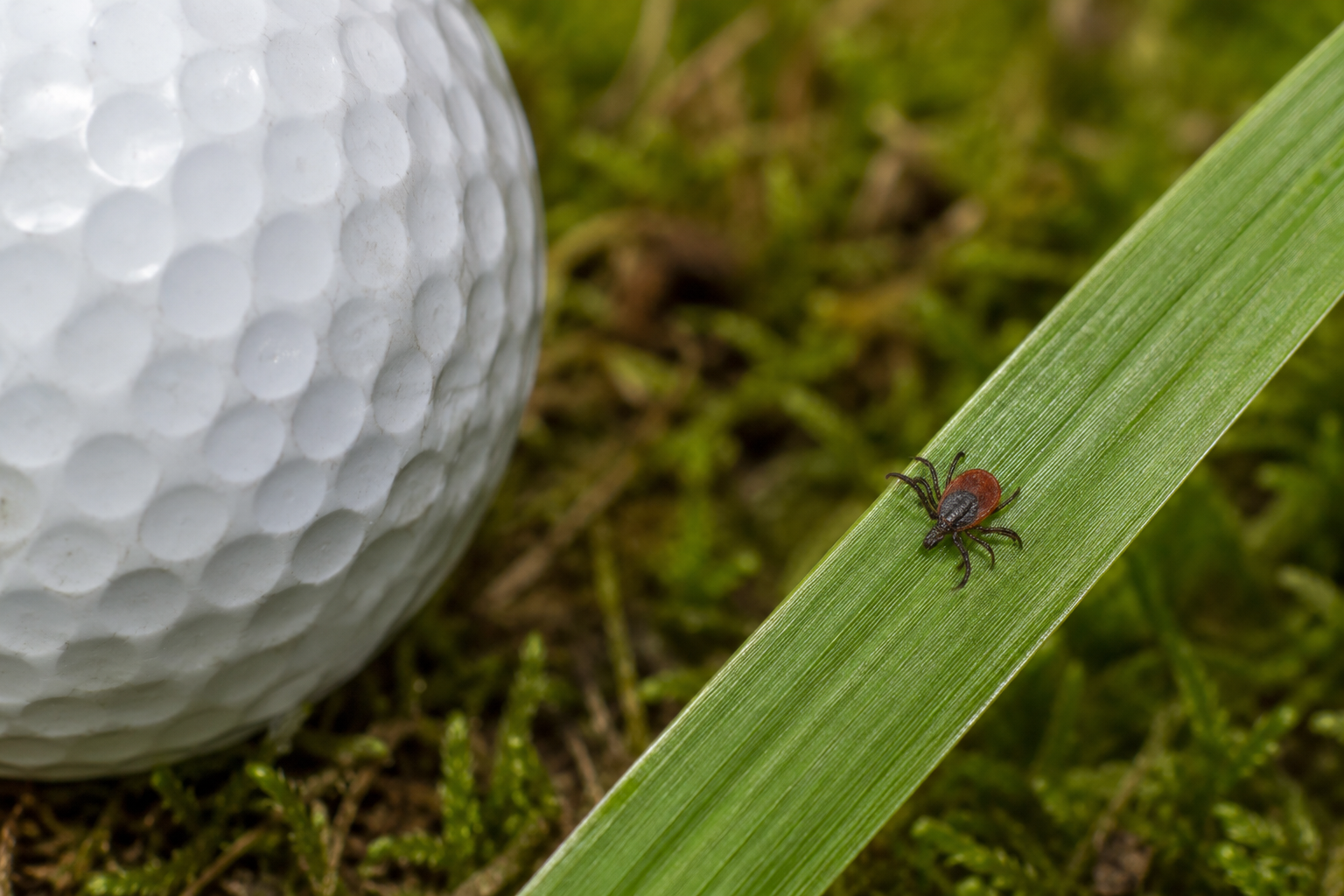
A tick is a small, oval-shaped arachnid with eight legs, more closely related to spiders and mites than to insects. Unfed, it's about the size of a sesame or apple seed, ranging from reddish-brown to black. Once it feeds, it swells and turns grayish or bluish, sometimes reaching the size of a small grape. Below, we'll cover the species most common in North Carolina yards and where they're most likely hiding on your property.
Types of Ticks Found in North Carolina
If you've pulled a tick off yourself, your kid, or your dog this year, it was probably one of these five.
American Dog Tick
Reddish-brown body with mottled white or cream markings on its back. Females show a pale shield near the head. Males have finer, lace-like white patterning across the whole back. Fully engorged females can reach roughly half an inch, noticeably bigger than what most people expect a tick to look like. Common in grassy fields, open meadows, and trail edges.
Black-Legged Tick (Deer Tick)
Smaller than the American dog tick, with a reddish-orange body and dark legs. Females often show a darker patch near the head against an otherwise orange-brown body. Males are uniformly dark brown to black. This is the species most associated with Lyme disease risk in North Carolina, and it's the one you're most likely to pick up along a shaded yard edge or wooded property line.
Lone Star Tick
Rounder body and larger mouthparts than other local species. Females carry a single bright white dot on their back. Males lack this marking and show faint white streaking along the edge instead. If you were in heavy underbrush and something bit you fast, this is a likely culprit. Lone star ticks actively seek out a host rather than waiting to be brushed against.
Brown Dog Tick
Narrow, elongated reddish-brown body without bold markings. If your dog spends time near a kennel or dog run, this is the one to watch for. It can complete its entire life cycle indoors, which is part of why infestations around pet bedding stick around.
Asian Longhorned Tick
Reddish-brown body with long legs of the same color and small mouthparts. Mostly targets livestock and pets rather than people, but worth knowing if you keep animals, since its numbers have been growing statewide.
Where Ticks Hide in NC Yards
If you're wondering where that tick came from, it's worth thinking about which part of the yard you were actually in. Ticks favor humid, shaded conditions and avoid direct sun and short, dry grass, so they tend to cluster in the same few spots:
- Tall grass and unmowed edges
- Leaf litter and mulch beds
- The border where lawn meets woods
- Areas with heavy brush or ground cover
- Woodpiles and stone walls
If your last few tick encounters trace back to the same corner of the yard, that's not a coincidence. Keeping these zones trimmed and managed reduces the habitat ticks rely on, which is part of why yard-focused treatment plans target these specific transition areas rather than the whole lawn evenly.
Keep Ticks Off Your Property

Once you know what to look for, spotting a tick on yourself, your kids, or your dog gets a lot less unsettling. We treat the yard conditions that draw ticks in, with a lower-toxicity approach designed to be kid-friendly, pet-friendly, and pollinator-friendly, the same approach that placed us among the top flea and tick yard treatment companies in Atlanta. Get started to see what that looks like for your property.
FAQ
What does a tick bite look like compared to a mosquito bite?
A tick bite often shows a small red bump at the attachment site, and the tick itself may still be attached when you notice it. It typically doesn't itch right away, which is part of why bites go unnoticed for hours or even days.
Can you see a tick with your bare eyes?
Adult ticks are visible without magnification. Nymphs and larvae are extremely small and easy to miss, especially in hair, behind ears, or in skin folds.
Do all ticks in North Carolina carry disease?
Not every tick carries a pathogen. Several NC species are known to transmit illnesses like Lyme disease, Rocky Mountain spotted fever, and ehrlichiosis, which is why prompt removal and yard management both matter.
Where in my yard should tick treatment focus?
On the shaded, humid transition areas where ticks actually live and quest: unmowed edges, leaf litter, mulch beds, and the border where lawn meets woods.